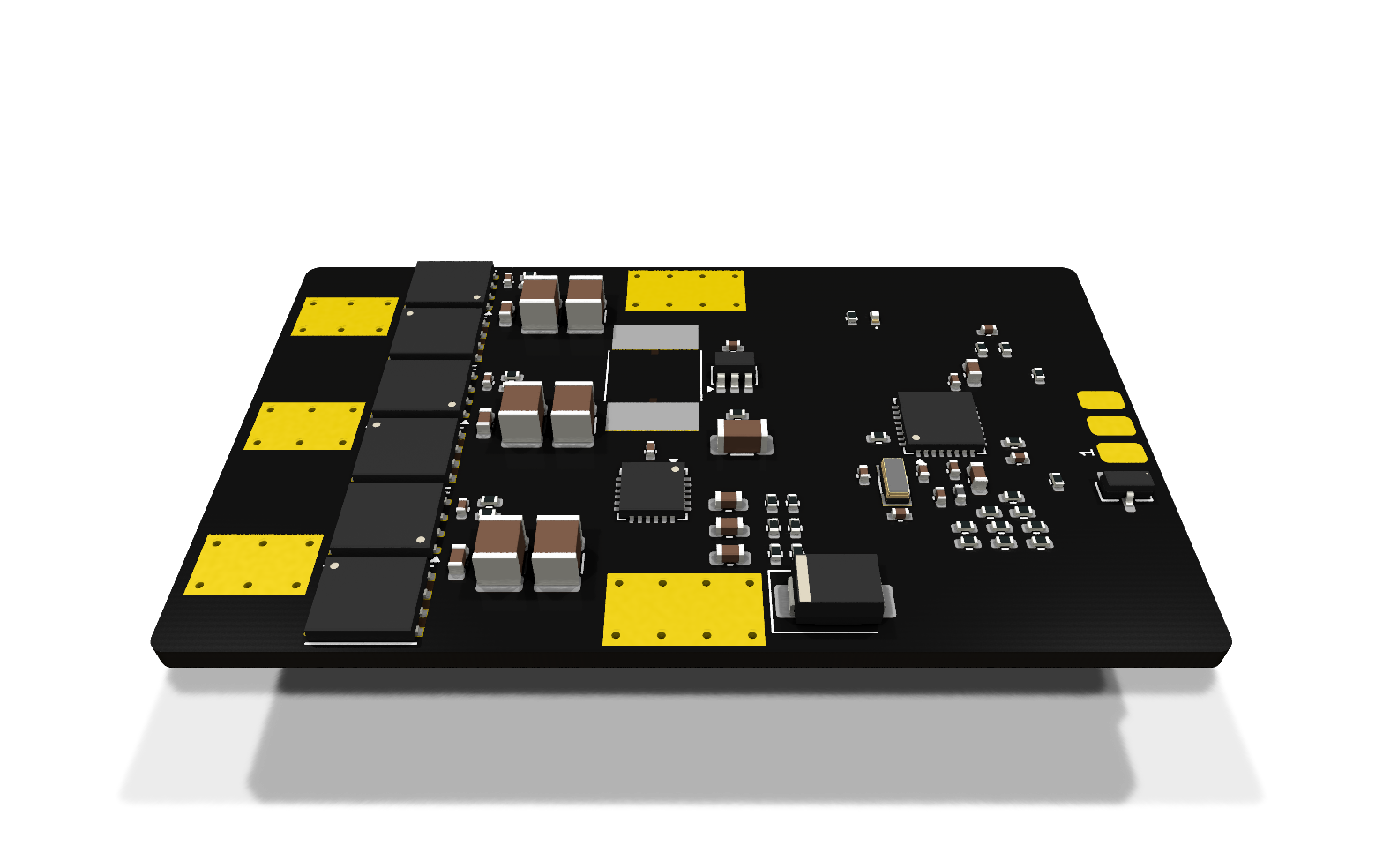
PrototypeComing soon

YUKE AM32 DroneCAN ESC

6S, 50 A continuous / 70 A burst single brushless ESC: AM32 firmware, DroneCAN communication, Kelvin-shunt current sensing and a 2 oz copper power board.

YUKE AM32 DroneCAN ESC

YUKE AM32 DroneCAN ESC is a single-motor drive sized for T-Motor AT3520 KV550-class propulsion. The power stage uses six 0.70 mΩ Infineon BSC007N04LS6 MOSFETs and a TI DRV8300 gate driver; control runs on an 80 MHz STM32L431 with a TJA1051 CAN transceiver. Current is measured through a Kelvin-connected 0.2 mΩ shunt and an INA180, bus voltage through a divider. Two JST-GH CAN ports allow daisy-chaining, the JP1 bridge enables 120 Ω termination at the end of the bus, and a DShot/PWM input is kept as well.

Specifications

Input voltage
3–6S LiPo (25.2 V max)
Current
50 A continuous · 70 A burst (with prop airflow or a heatsink)
Power stage
6× Infineon BSC007N04LS6 (40 V, 0.70 mΩ) · TI DRV8300
Processor
STM32L431KCU6 · Cortex-M4 · 80 MHz
Firmware
AM32 (based on REF_L431_CAN)
Communication
DroneCAN 1 Mbit/s · DShot/PWM input · telemetry pad
Current sensing
0.2 mΩ Kelvin shunt + INA180A3 · 20 mV/A · 164 A full scale
Connectors
2× JST-GH 4P CAN (daisy-chain) · 120 Ω termination bridge · SWD pads
Protection
SMBJ26A TVS · NUP2105L CAN ESD · MCU temperature protection
PCB
35.4 × 60 mm · 4-layer, 1.6 mm · 2 oz outer copper · ENIG
Availability
Prototype, coming soon

This board is not on sale yet

This board is in the prototype stage. Ask us to let you know when the first production batch is ready, or write to us for samples, volume or custom versions.

The buttons open your email app. You can also write directly to [email protected]

Variants

Rev A prototypeYK-ESC-AM32-50A-A
PrototypeLead time: Coming soon

Compatibility

Software and interfaces this board is designed to work with. Test results are added to the docs as they come in.

  • DroneCAN
  • AM32
  • ArduPilot (DroneCAN ESC)
  • DShot / PWM

Design notes

Board architecture and design choices. Values are design targets and are updated as bench and flight tests confirm them.

Power stage

A power stage calculated for 6S / 50 A

The current ratings come from calculation rather than guesswork: the 50 A continuous figure is derived from the AT3520 KV550 motor's 180-second rating, and 70 A is a short-term checkpoint for take-off and gust loads. The model combines temperature-dependent Rds(on), switching, dead-time, Qrr/Coss, copper and via losses.

  • 6 × BSC007N04LS6 (0.70 mΩ) MOSFETs and a DRV8300 with 10 V GVDD; 4.7 Ω high-side and 2.2 Ω + 10 nF low-side gate tuning.
  • 4 layers with 2 oz outer copper: 5.6 W calculated copper loss at 50 A, with calculated board and MOSFET temperatures of about 72 / 75 °C in prop airflow.
  • 8 × 10 µF MLCCs and 2 × 100 µF polymer capacitors; a 470 µF low-ESR capacitor is recommended on the system side.
  • An approximately 33 × 15 mm copper area on the bottom side is reserved for an external heatsink.
Sensing and communication

A drive that takes DroneCAN commands and measures itself

AM32 running on an STM32L431 takes its commands over DroneCAN, with a 32.768 kHz crystal for accurate CAN timing. Current is measured through a Kelvin-connected 0.2 mΩ shunt and a ×100 INA180, and bus voltage through a 26:1 divider.

  • Current sensing runs at 20 mV/A with a 164 A full scale, ready for calibration.
  • Two JST-GH CAN ports allow daisy-chaining; the JP1 bridge enables 120 Ω termination on the last ESC of the bus.
  • A DShot/PWM input and telemetry pad remain for non-CAN systems, and SWD pads simplify firmware loading.

Setup and docs

Port maps, wiring and setup guides for this board.